

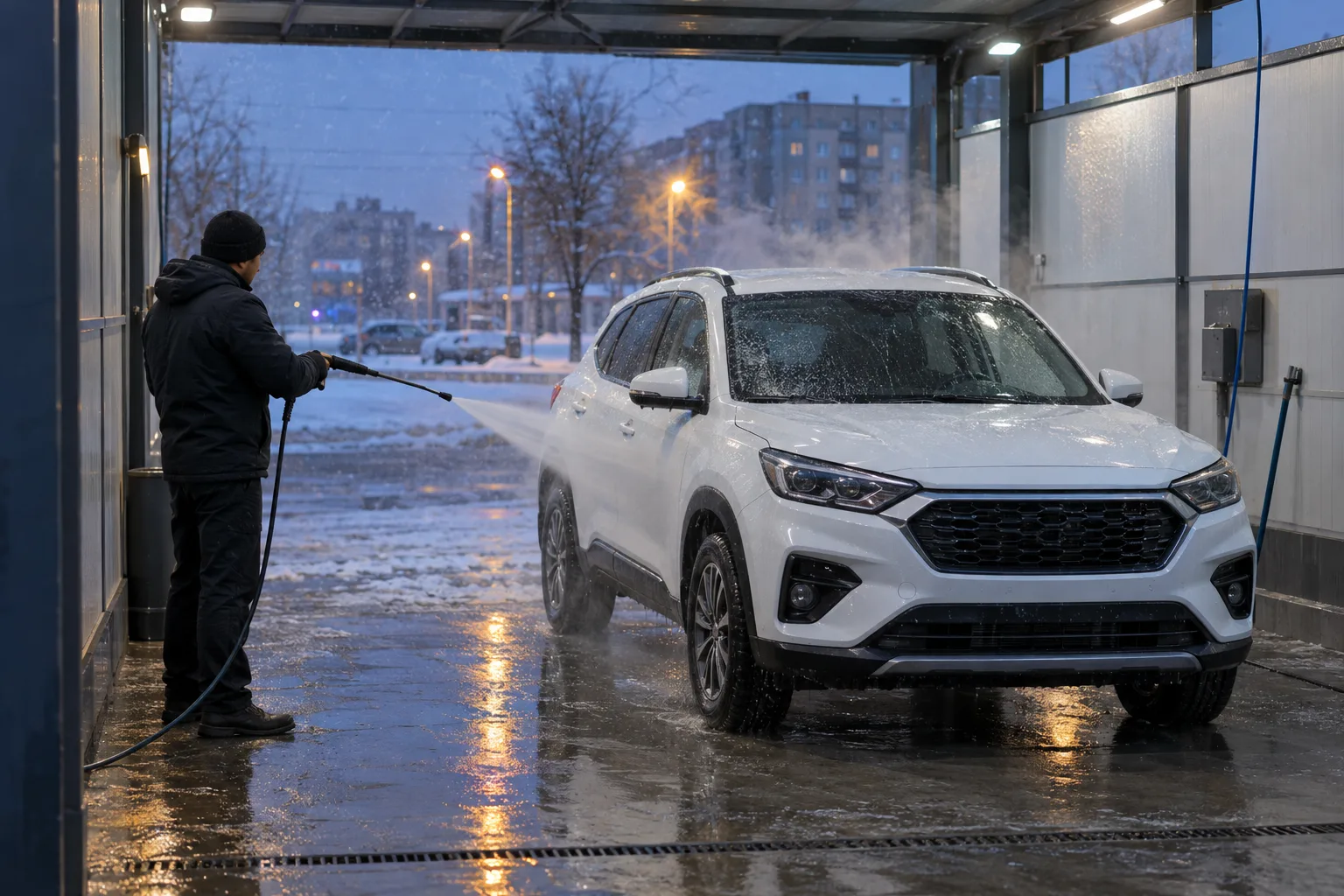
Winter is the toughest season for paint protection film: road salt and grit, freeze-thaw cycles in Almaty, hard frosts in Karaganda, queues at the car wash and the temptation to scrape off ice in a hurry. The film copes with all of it, as long as you do not help it fail. Here are the key rules for winter care.
- During the road-salt season, wash every 7–10 days, and within 1–2 days after heavy gritting.
- Keep a pressure washer at least 50 cm away, use a fan spray and never aim at the film edges.
- No brush car washes and no scrapers on the film.
- Do not pour hot water on a frozen body, and do not drive out into the frost with wet edges.
- Inspect the film edges before and after winter.
If the car was wrapped in autumn or winter
Adhesive cures more slowly in the cold, so studios recommend a longer no-wash period in cold weather:
- no washing at all for the first 3 days, and the first touchless wash after 14 days rather than the 7 days typical in summer;
- if the car gets badly splashed, rinse it with a hose without pressure and blot with microfibre, keeping away from the edges;
- after installation, keep the car somewhere warm for at least 12 hours, ideally 24, before it goes out into the frost;
- do not use a pressure washer in the first week, and close the doors gently.
Light haze and small water pockets under the film during the first weeks are normal. They usually clear within 2–4 weeks; in winter, closer to the upper end.
How often to wash
The real danger is less the salt itself than grit-laden dirt that settles into the top coat and scratches it at every touch. So in winter you need to wash more often than in summer:
- with daily driving, every 7–10 days;
- after snowfall and heavy gritting, within 1–2 days, never leaving salt on for weeks;
- if the car mostly sits in a garage, 1–2 times a month.
A warm garage does not replace washing: snow on the body melts and mixes with the salt.
How to wash properly
Pressure washer
- Distance. Recommendations vary from 50–60 cm to 90 cm. A simple rule: no closer than half a metre, and further if you do not know which film you have.
- Spray. Fan spray only. Keep rotating "turbo" nozzles away from the film.
- Edges. Never aim the jet at a film edge: the leading edge of the bonnet, bumper ends, around the headlights and mirrors. Move the jet from the film towards bare paint, not against the edge.
Chemicals
- Use a pH-neutral shampoo, roughly pH 6–8.
- Be careful with aggressive snow foam at pH 12–13: with regular use it can make the top coat rough and cloudy. Rinse touchless chemicals off within 1–2 minutes and never let them dry.
- Acetone, petrol, solvents, dish soap, abrasive compounds and melamine sponges are not suitable for film.
Brush car washes
Brushes pick up grit and dull the top coat, and they can catch a film edge. A touchless wash or a hand wash ("foam first, then a soft mitt") is safer.
Frost and temperature swings
- No thermal shock. Do not pour hot water on a body frozen to −15 °C. Let the car stand in the wash bay for 5–10 minutes first, or start with cool water.
- Dry edges. Always dry the film edges after washing. At −10 °C, water in the gap at an edge freezes, expands and lifts the film. In winter it is best to wash in a heated bay with drying.
- Drying. Blot with microfibre rather than rubbing; an air blower is even better. Do not use silicone water blades.
Snow, ice and brushes
- Sweep snow off with a soft brush without pressing it into the body. Leave the last thin layer; warming up the car will melt it.
- Do not scrape ice off the film. Warm the car up or use a de-icer. An ice scraper or a stiff snow brush will scratch the film, and that kind of damage is usually not covered by the warranty.
- Do not chip ice off the edges of the bonnet and bumper: removed carelessly, it can pull a film edge.
- Choose a good-quality screen wash. Cheap methanol-based fluids may cloud polyurethane film on headlights.
Protecting the film before winter
In autumn it helps to deep-clean the film of tar and iron particles, then refresh the hydrophobic layer:
- A quartz spray for PPF takes minutes to apply and lasts several washes. Refresh this kind of layer every 3–6 months.
- A ceramic coating for film lasts longest. It is applied by specialists in a bay, and no sooner than 2–4 weeks after installation.
- Hard wax is difficult to apply in the cold and can leave white residue in the seams.
- Matte and satin film need products made for matte surfaces only; wax and polish will leave them blotchy.
Edge inspection
Twice a year, before and after winter, check in daylight the leading edge of the bonnet, the bumper ends, the edges around the headlights and mirrors, and the lower door edges. If an edge has lifted by 1–2 mm and is clean underneath, a studio can usually re-stick it. If dirt has already got under it, the film on that panel is usually replaced. Do not pull or trim an edge yourself.
Tip: self-healing in winter
The PPF top coat closes fine scratches with heat, but in the frost the effect barely works. To remove fresh marks, put the car in a warm bay, let it warm through and pour water at about 50–60 °C over the scratch. Never do this on a frozen body; see the thermal shock rule above.
- Wash every 7–10 days, and within 1–2 days after gritting.
- Pressure washer from 50 cm, fan spray, away from edges.
- pH 6–8 shampoo; never let chemicals dry.
- No brush washes, scrapers or dry-wiping dirt.
- No hot water on a frozen body.
- Dry the edges before driving into the frost.
- Check the edges before winter and in spring.
Everything you need for winter film care — pH-neutral shampoos, touchless chemicals, quartz sprays for PPF, microfibre towels and soft brushes — is available in our store.
Our white Chery Tiggo 2 Pro with a PCU-based film is going through its first winter. We will show how the film handles road salt, frost and washing, compared with the unprotected areas of the body. To have your edges checked or get care advice, visit an official IONX installation center.