

In 2025–2026 the abbreviation PCU started showing up in more and more paint protection film listings. Sellers promise it will not yellow, will last longer and will cope better with moisture. Here is what open sources say about it: where PCU is genuinely stronger, and what the marketing usually leaves out.
- PCU is a polycarbonate-based polyurethane. In practice it is a type of TPU with a different "soft" block in the molecule.
- Its main proven advantage is much higher resistance to hydrolysis, meaning breakdown caused by moisture and heat.
- Its weak points: it is less elastic and harder to install on complex curves, and early formulations had questions around low-temperature behaviour.
- The word "PCU" on the box guarantees nothing by itself. Documentation, top coat, adhesive, warranty and the installer matter more.
What PCU is
PCU stands for polycarbonate urethane, a polyurethane based on polycarbonate. Classic PPF is made from thermoplastic polyurethane (TPU). Its molecule has two parts: a hard segment that provides strength and a soft segment that provides elasticity.
The soft segment can be one of several types:
- polyether;
- polyester, including polycaprolactone, which most familiar films are based on;
- polycarbonate, which is what PCU means.
So PCU is better described as a branch of TPU than as its rival. That is how the Taiwanese studio JieJiang describes it, for example. Its raw material is polycarbonate diols (PCDL). They have long been used in sealants, insulation and synthetic leather, and their noticeable growth in films started in 2025, according to Vinyl Russia.
Where PCU is stronger
Moisture and heat
This is the main and best-supported argument. The ester bond in ordinary polyurethane breaks down in water over time, especially when warm, while the carbonate bond is far more stable. A materials data review by PatSnap gives these figures:
- after 28 days in 70 °C water, polycarbonate polyurethane keeps more than 90% of its tensile strength, while polyester polyurethane loses 40–70%;
- after 168 hours in air at 150 °C, PCU loses less than 10% of its strength, while polyester formulations lose 30–50%.
These are figures for the raw materials, not tests of specific films, but they show a clear direction.
Ageing and stiffening
Distributors and detailing studios say PCU stays elastic longer and is less prone to embrittlement and delamination. Vinyl Russia and Favorit Detailing both report this. Neither gives figures or test methods, so this is market experience rather than measurement.
Where PCU is weaker
Installation
Polycarbonate polyurethane is slightly harder. Chenmei Auto, a studio that has worked with this film, says it is harder to stretch when heated. It lays well on flat panels, but complex curves need more cutting and segmented installation, so the installer's skill matters even more.
Cold
Patent literature, such as Asahi Kasei's US8318890B2 (discussed by JieJiang), notes that traditional polycarbonate formulations tend to crystallise and keep less flexibility at low temperatures. Manufacturers address this through formulation, but the issue matters more for a Kazakh winter than for the tropics, where PCU is usually marketed.
A young technology
Classic TPU has been used in films for over a decade, and installers know it well, notes CAX Vinyl. PCU films do not yet have that kind of real-world track record.
What the marketing rarely explains
PCU listings include promises such as "three times the hydrolysis resistance" or "15-year warranty". CAX Vinyl and EcoFilm, for example, use this kind of wording. These are manufacturer claims, usually published without test methods or independent verification.
More importantly, yellowing resistance depends more on whether the polyurethane is aliphatic and on the quality of the top coat than on the PCU label itself. Self-healing of fine scratches also comes from the top coat, not the base (JieJiang). A good PCU film and a good TPU film may be closer to each other than a good PCU film and a bad one.
How to choose a PCU film
- Technical data sheet (TDS). It should state clearly that the soft segment is polycarbonate, not just put "PCU" in the product name.
- Aliphatic polyurethane. This is the key to yellowing resistance, especially on white and light-coloured cars.
- Layer structure. Ask what the top coat and adhesive are made of and how many layers there are.
- Written warranty. It should name yellowing, edge lifting and bubbles explicitly, not just "material defects".
- Serial number and installation record. These make the warranty actually verifiable.
- The installer. Ask whether the studio has installed PCU on complex parts such as bumpers, mirrors and pillars.
Aftercare
These rules are the same for PCU and TPU (Chenmei Auto):
- for the first 7 days, do not aim a pressure washer at the film edges;
- for 7–14 days, do not brush the edges;
- use a pH-neutral car shampoo and avoid strongly acidic or alkaline chemicals;
- check the edges regularly and go back to the studio at the first sign of lifting.
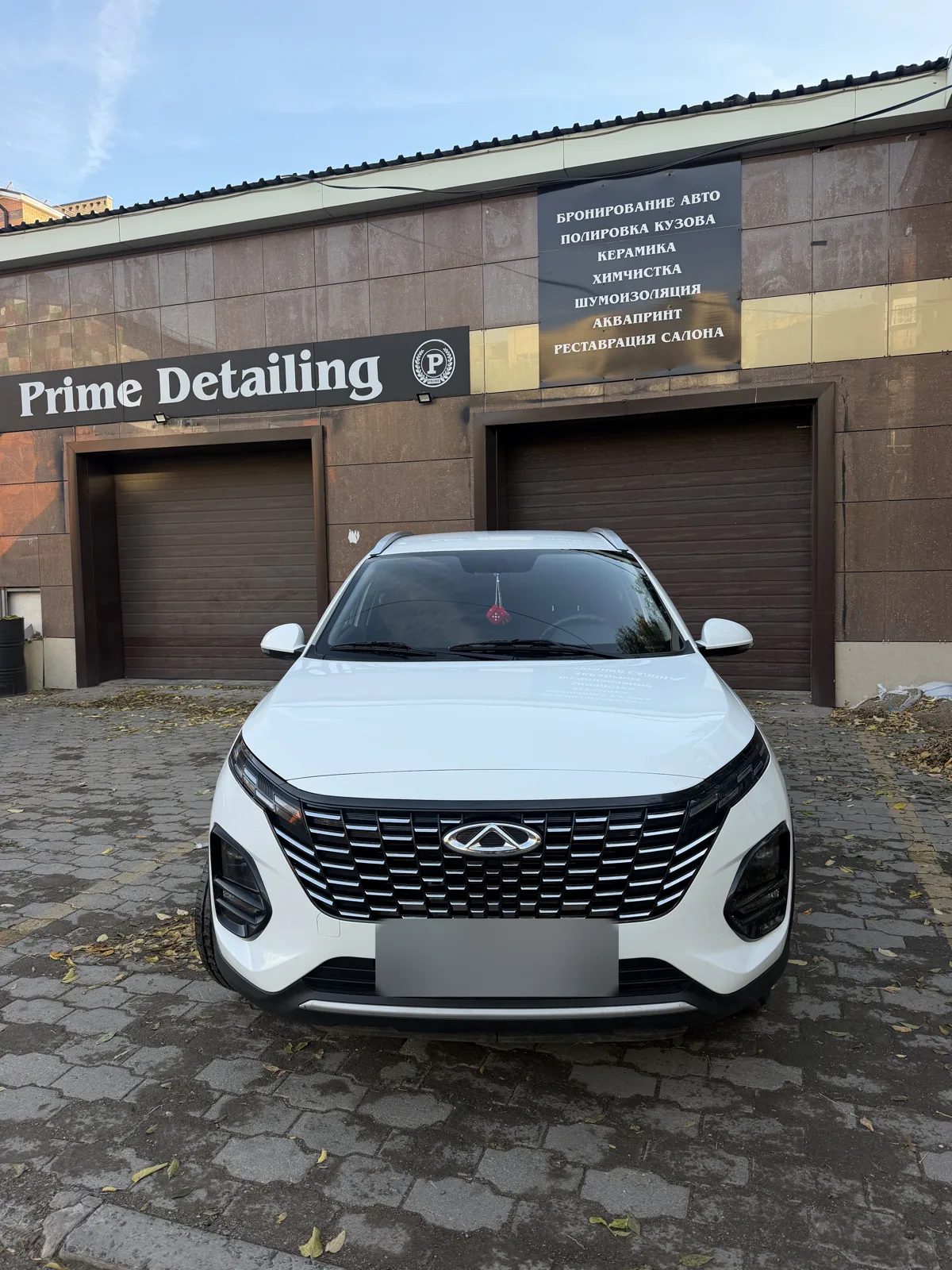
Lab figures and advertising promises are one thing; winter, road salt and highway driving are another. So on 9 October 2026 we wrapped a white Chery Tiggo 2 Pro in a PCU-based film and are publishing the results openly: yellowing, chips and edge condition. If the film performs well, it may join the IONX lineup.
Sources
- Vinyl Russia — PCU: a new stage in PPF development (RU)
- Favorit Detailing — why PCU films are replacing classic polyurethane (RU)
- PatSnap Eureka — Polycarbonate Based Polyurethane
- JieJiang — TPU, TPH, PVC and PCU film materials (ZH)
- Chenmei Auto — is PPF worth it, PCU vs TPU (ZH)
- CAX Vinyl — Differences Between TPU & PCU Paint Protection Film
- EcoFilm — PCU Paint Protection Film